HM3 remains a capable, proven tracker for Windows-based poker players seeking deep statistical insight, provided they are comfortable with the licence-plus-annual-maintenance model.
This review is based on official product information from the developer and published third-party sources. All details have been verified as of 26 October 2026. No hands-on testing was performed for this report.
Review summary
Hold’em Manager 3 (HM3) is a specialised software suite designed for online poker players who wish to use data to improve their game. It functions as a hand tracker, a reporting tool, and a Heads-Up Display (HUD) provider. By recording the history of every hand played, it allows players to build a database of their own performance and that of their opponents.
This software is best suited for serious online grinders in cash games and tournaments. Those who play regularly on major networks like PokerStars or 888 Poker will find its statistical depth highly beneficial. It is particularly useful for players who want to move beyond intuition and begin making decisions based on concrete statistical trends.
The primary strengths of HM3 lie in its long-standing reputation, its mature feature set, and its specialised tools like Notecaddy. It offers a HUD that provides at-a-glance information at the table. However, its main drawbacks include its Windows-only requirement and a licensing model involving annual Support and Maintenance (S&M) fees, which can be confusing for new users.
Verdict: HM3 remains a capable, proven tracker for Windows-based poker players seeking deep statistical insight, provided they are comfortable with the licence-plus-annual-maintenance model.
Quick facts
| Feature | Details |
|---|---|
| Software name | Hold’em Manager 3 |
| Developer | Max Value Software LLC |
| Product category | Poker Hand Tracker and HUD |
| Official website | holdemmanager.com |
| Windows compatibility | Yes |
| macOS compatibility | No |
| Linux compatibility | No |
| Mobile support | No |
| Supported poker variants | Texas Hold’em, Omaha |
| Main functions | Hand tracking, HUD, reporting and queries, Notecaddy |
| Free version or trial | 14-day free trial available |
| Pricing model | One-time licence + annual Support & Maintenance (S&M) |
| Current price (verified 26 Oct 2026) | Official site (verified 26 Oct 2026): $65 Small Stakes / $100 All Stakes per format; $100 / $160 Holdem + Omaha combos; S&M $44.99–$99.99 per year |
| Latest version | HM3 (no build number published) |
| Last verified date | 26 October 2026 |
What is Hold’em Manager 3?
Hold’em Manager 3 is a data-driven toolset designed to assist online poker players in analysing their gameplay. At its core, it is a hand tracker. This means the software works in the background while you play, reading the hand history files that poker sites generate and importing them into a local database.
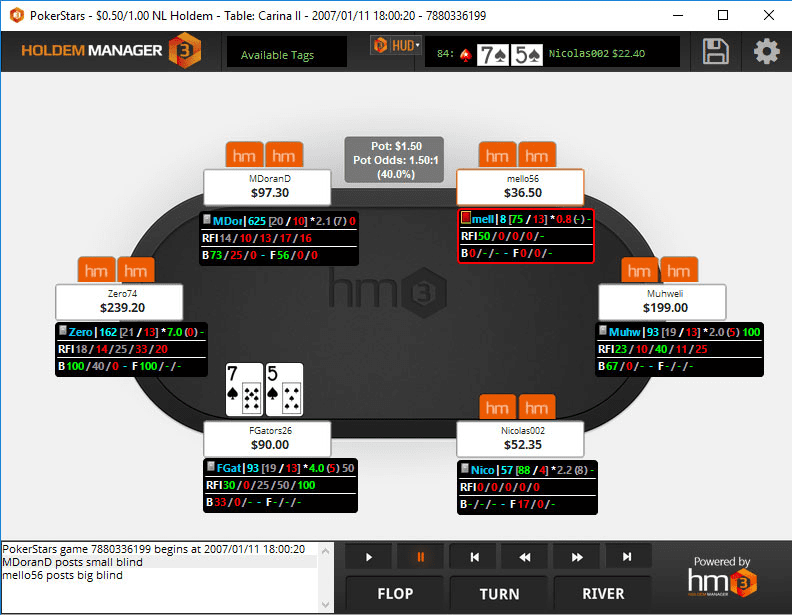
Once this data is stored, HM3 provides two main ways to interact with it. The first is the Heads-Up Display (HUD). This is a small overlay that appears on top of your poker client. The HUD shows statistics for your opponents, such as how often they call or raise in particular situations. This gives you context at the table without having to recall every session.
The second way to interact with the data is through the reporting and query tools. This is where the bulk of study happens. Instead of looking at a single hand, you can ask the software questions such as: “What is my win rate when I play a strong hand out of position?” or “How does this opponent play from the Big Blind?”
According to the company, HM3 has been used by over a million online cash game and tournament players since it was first launched more than 12 years ago.
Who should use it?
Because of its depth, HM3 is not a tool for every poker player.
Beginners If you are still learning the basic rules of poker or hand rankings, HM3 may feel overwhelming, and a busy HUD can be a distraction during play. However, a motivated beginner who wants to learn from their own data from day one can use it as a structured tutor.
Intermediate Players This is the primary demographic for HM3. Intermediate players often have a basic grasp of the game but struggle with consistency. HM3 helps them identify “leaks” — repetitive mistakes that cost money over time. By seeing their own statistics, they can pinpoint where their play deviates from what the data suggests.
Advanced Players and Grinders For professional players or high-volume grinders, HM3 is a staple of the workflow. At this level the edges are small, and the ability to run complex queries and use the Notecaddy system to categorise opponent behaviour matters.
Coaches Coaches can use the software to review their students’ hand histories in detail, showing actual statistical trends rather than relying on memory.
Main features
HM3 offers a comprehensive suite of features covering the data side of online poker.
HUD (Heads-Up Display) The HUD overlays statistical data onto the poker table, calculated from the hand histories in your database. Common statistics include how often a player voluntarily puts money in the pot (VPIP) and how often they raise pre-flop (PFR). The display is customisable, so you choose which statistics appear and where.
Hand Tracking and Database Management The software stores and organises your hand history, which you can filter by date, site, game type or opponent. This organisation is what makes meaningful long-term study possible.
Notecaddy Notecaddy is a semi-automated note-taking application included with HM3. Rather than typing a comment by hand, it reads hand histories and suggests relevant notes based on observed behaviour, helping you build a profile of how opponents actually play.
Ignition Hand Grabber Some poker sites do not write hand histories to your computer in a usable form. The Ignition Hand Grabber, included with HM3, creates the hand history files where they are missing, extending tracking to otherwise unsupported situations.
Reporting and Querying The reporting engine covers profit and loss, win rates across stakes and game types, and tournament performance. The query tools let you drill into any combination of filters you can think of.
Limitations HM3 is not a solver. It tells you what has happened, not what a GTO strategy would prescribe. The “Small Stakes” version also limits how many hands it will track, which eventually pushes long-time users to the Full Version.
Ease of use
The HM3 interface is professional and information-dense. Initial setup — installing the software, connecting your database, and making sure your poker client saves hand histories — takes a bit of patience, and most first-time users should follow a setup guide so tracking starts correctly.
Once running, the HUD is fairly easy to customise: you choose which statistics appear and how they are arranged. The reporting side has a steeper learning curve; getting the most from the query tools means learning how to build specific filters.
Practical examples
Two realistic study situations show what HM3 is for.
Scenario A: Identifying a Calling Station You play a mid-stakes table on PokerStars and notice an opponent who seems to play too many hands. Their HUD shows a high VPIP (they put money in the pot voluntarily a large share of the time) and a low PFR (they rarely raise pre-flop). That pattern describes a “calling station” — someone who sees many flops but rarely raises. You can adjust by betting more for value when you hold strong hands and folding up more readily when you hold marginal ones.
Scenario B: Finding a Positional Leak After a week of tournaments you run a report split by position. It shows your results are significantly worse from early position than from the late seats. That suggests you are opening too wide from early seats, and your study time is best spent tightening those ranges.
Performance and system requirements
HM3 performs heavy database operations and runs a real-time HUD overlay, so it is a resource-intensive application.
The company does not publish a single “minimum spec” that guarantees performance. A modern Windows PC is expected; a fast SSD helps database queries and hand imports run quickly, and 8GB or more of RAM is a sensible baseline to keep the software from slowing your poker client during long sessions.
Pricing and value
HM3’s pricing model needs explaining, because it is not a simple “pay once, nothing ever again” model — although the licence itself is a one-time purchase.
The licence and S&M model When you buy an HM3 licence you receive lifetime access to that version of the software, plus one year of Annual Support & Maintenance (S&M) free. S&M is what delivers software updates, technical support and fixes for new poker client versions. After the first year, S&M renews annually if you want those benefits. If it lapses, you can still use the version you have installed; you simply stop receiving updates. Because poker rooms occasionally change how they store hand histories, a long-lapsed installation may eventually stop importing new hands correctly. You can resume S&M for up to two years after expiry, with a discount if you renew within that window (official FAQ).
Official S&M prices (per year, verified 26 October 2026):
- Holdem or Omaha, Small Stakes: $44.99
- Holdem or Omaha, Full Version: $69.99
- Holdem & Omaha, Small Stakes: $69.99
- Holdem & Omaha, Full Version: $99.99
- Mixed (one Full + one Small): $84.99
Licence prices The developer now publishes its licence prices on the HM3 page (verified 26 October 2026): HM3 Hold’em Small Stakes $65, HM3 Hold’em All Stakes $100, OM3 Omaha Small Stakes $65, OM3 Omaha All Stakes $100, and Holdem + Omaha combos at $100 (Small Stakes) or $160 (All Stakes). Small Stakes licences limit the hands tracked and the stakes covered; All Stakes removes those limits. Every purchase includes a lifetime licence plus one free year of updates.
Advantages and disadvantages
Advantages
- Long-standing, proven platform (in use by over a million players, per the company).
- Powerful, customisable HUD.
- Notecaddy automates opponent note-taking.
- Includes the Ignition Hand Grabber for missing hand histories.
- Deep reporting for serious long-term study.
- Supports a wide list of major poker networks.
Disadvantages
- Windows only.
- Annual S&M costs continue after the first free year.
- Small Stakes version has hand-tracking limits.
- Steeper learning curve for advanced reporting.
Comparison with alternatives
When choosing a tracker, the current market looks like this.
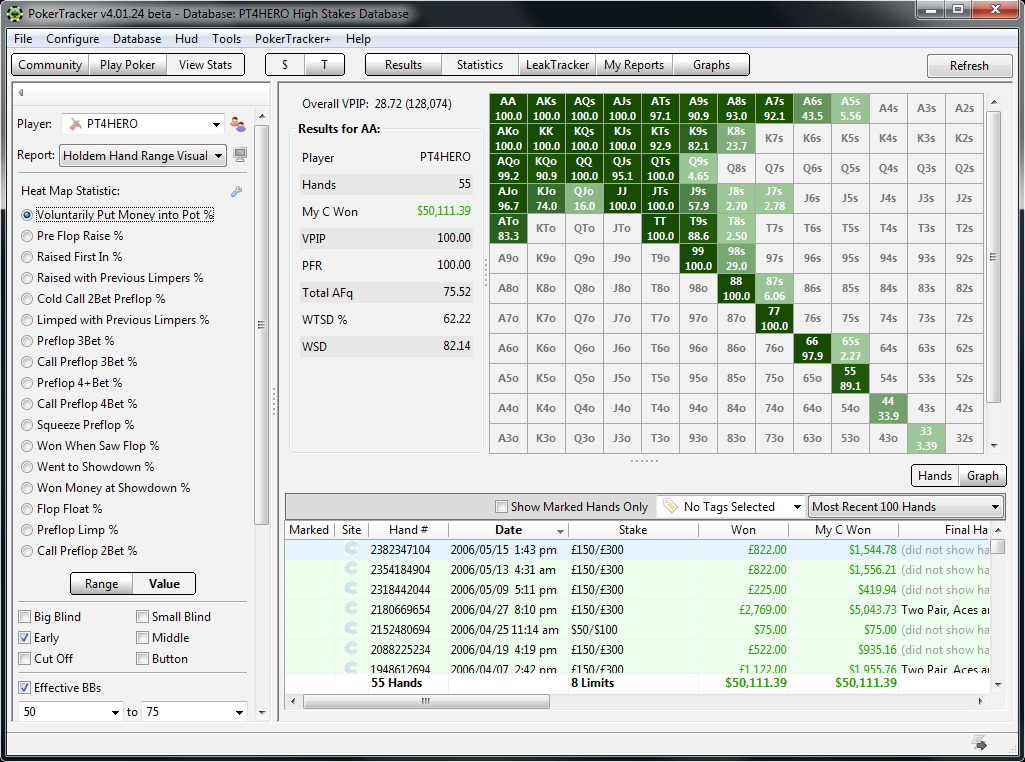
- PokerTracker 4 is the main competitor. It uses tiered one-time licences from $64.99 to $159.99, supports both Windows and macOS, and includes ICM and equity calculators.
- Hand2Note moved to a subscription-only model (from $15.99 per month, paid yearly) and is one of the few trackers with mobile app support. Its Learner plan caps the database at 200,000 hands.
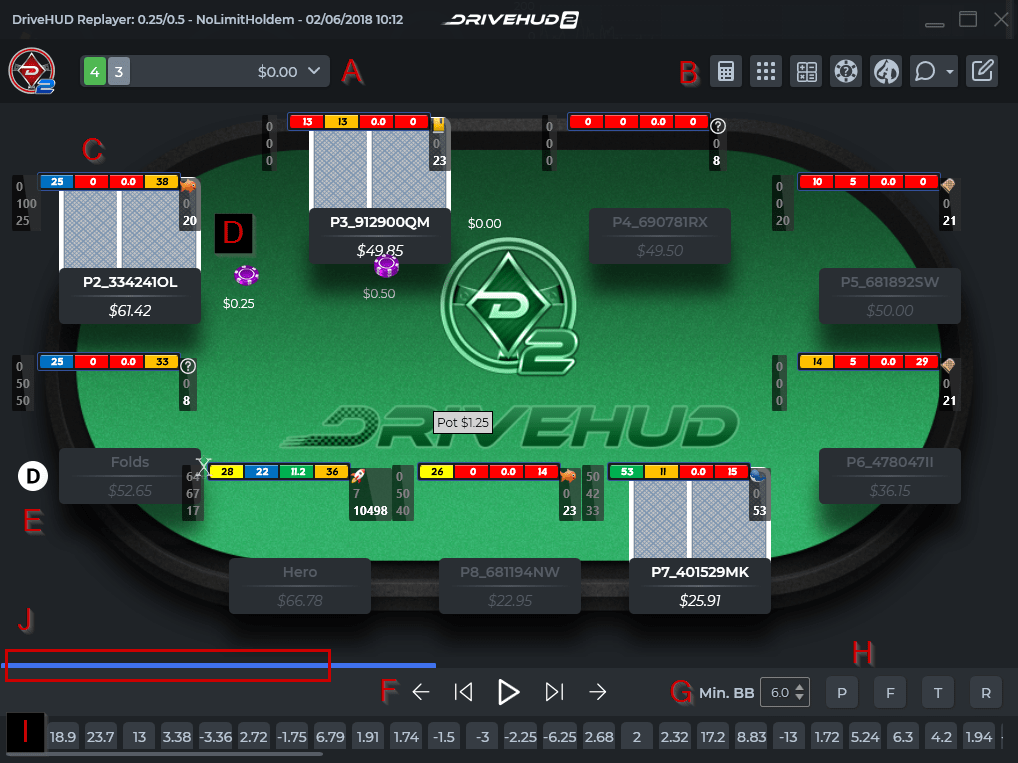
- DriveHUD 3 is often seen as the budget option: $59.99 for the first year on Core, renewing at $19.99 per year, with a built-in GTO solver and trainer.
- Poker Copilot uses a one-time price ($39, $69 or $99 by edition) and runs on both macOS and Windows.
For more options, see our Poker Trackers & HUDs category or our guide to the best poker HUDs.
Poker room rules and restrictions
Before installing any tracking software, check the rules of the rooms you play at.
Tracker and HUD software is generally permitted at many major online poker rooms, but the specifics vary: some rooms allow HUDs everywhere, others restrict which statistics may be shown or in which games, and a few restrict HUD use at certain table types. Real-Time Assistance (RTA) — software that tells you what to do while a hand is in progress — is prohibited at essentially every major room.
Because the rules differ between networks and can change, check each room’s software or anti-collusion policy page for its current position on HUDs and tracking before you rely on them.
Final verdict
Hold’em Manager 3 is a highly capable, proven piece of software. For Windows players serious about data-driven poker, its depth of reporting is difficult to match, and the combination of a flexible HUD and the Notecaddy note system makes it useful for both cash and tournament play.
The annual S&M fees and the Windows-only requirement are real trade-offs. If you can live with them, HM3 is a justifiable investment; if you are on a Mac, PokerTracker 4 or Poker Copilot are the natural alternatives.
FAQs
Can I use HM3 on a Mac? No. HM3 is developed for Windows only; there is no native macOS version. Mac players should look at PokerTracker 4 or Poker Copilot.
What happens if I stop paying for S&M? You can keep using the version you already own. You simply stop receiving updates and technical support. If poker room file formats change, an old installation may eventually stop importing new hands correctly. You can resume S&M for up to two years after expiry, with a renewal discount.
Is HM3 considered cheating or RTA? No. HM3 is a statistical tool: it shows what has happened historically. It does not tell you what to do in a live hand, which is what RTA is. As with any HUD, check the specific room’s rules.
Can I try it before buying? Yes — a 14-day free trial is available, distributed via PokerStrategy.
Does HM3 work with my poker site? It supports a wide list of networks, including PokerStars, partypoker, iPoker Network, Winning Poker Network, 888 Poker, Horizon Network, Winamax, Merge Network, People’s Poker, Asian Poker Clubs and Ignition. If your site is not on the list, check the company’s current supported-sites page.
Relevant alternatives
- PokerTracker 4 review — one-time licences, Windows + macOS
- Hand2Note review — subscription model with mobile apps
- DriveHUD review — budget option with built-in GTO tools
- Poker Copilot review — one-time price, macOS and Windows
- Poker Trackers & HUDs category — every tracker we cover