The no-fuss, free, fast way to do equity maths on Windows — nothing more, nothing missing.
This review is based on official product information and published third-party sources, verified as of 18 October 2026. No hands-on testing was performed for this report.
Review summary
PokerStove is a long-standing, free equity calculator for Windows. You give it hands (or sets of hands) and a board, and it tells you the probability — the “equity” — of winning at showdown. That is the whole product, and it has done that job reliably for players for years.
It is not a modern app. The interface is dated, there is no database, no tracking and no strategic advice. In exchange it is completely free, extremely lightweight and fast — it runs on hardware where heavier modern tools would struggle.
It suits anyone who wants a quick mathematical check on how one set of hands performs against another, preflop or postflop. It is a calculator, not a coach: if you need strategy answers, that is solver territory.
Verdict: the no-fuss, free, fast way to do equity maths on Windows.
Quick facts
| Feature | Detail |
|---|---|
| Software name | PokerStove |
| Developer | Andrew Prock |
| Product category | Poker equity calculator |
| Official website | github.com/andrewprock/pokerstove |
| Windows compatibility | Yes |
| macOS compatibility | No |
| Linux compatibility | No |
| Mobile support | No |
| Supported poker variants | Texas Hold’em |
| Main functions | Hand/range equity, preflop and postflop, board runout |
| Free version or trial | Free |
| Pricing model | Free |
| Current price (verified 18 Oct 2026) | Free |
| Latest version | See the GitHub repository releases |
| Last verified date | 18 October 2026 |
What is PokerStove?
PokerStove is a classic Windows desktop program that calculates hand equity. Equity is the mathematical probability that your holding wins the pot at showdown — the moment betting stops and cards are revealed.
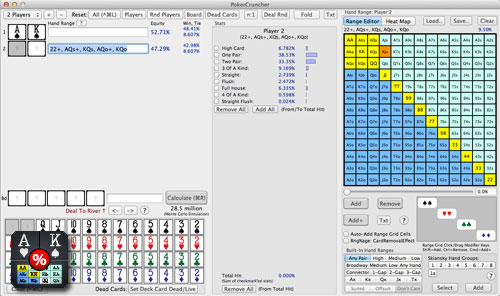
The workflow is minimal: you enter your cards (or a defined set of hands) and your opponent’s cards or set of hands, and PokerStove computes how often you win. It works preflop (before community cards) and postflop (after the flop, turn or river): add the board cards and the equity shifts accordingly.
It is a pure mathematical utility. It does not track your hands, keep a database, import histories or advise on betting. It gives you numbers, fast.
Who should use it?
Beginners A good, low-pressure way to build equity intuition. Watching a pair of aces’ win rate against random hands, then against tighter holdings, teaches the scale of hand strength in a way articles only hint at.
Intermediate players Use it to check how your assumed ranges interact on specific boards, and to test the “obvious” answers your experience gives you. Most surprises in poker study are small, but they compound.
Advanced players and coaches A quick sanity check during study, and a teaching tool: showing a student the equity swing a single board card makes takes seconds.
Cash and tournament players The equity maths is the same in both; PokerStove simply does not model tournament-specific chip value (that is ICM territory — see the comparison with ICM tools in section 11).
Main features
Hand and range-versus-range equity The core function: pit specific holdings, or defined sets of hands, against each other and read the win percentages.
Preflop and postflop Run the calculation before any community cards, or add the flop (and later streets) to see the equity evolve as the board develops.
Lightweight by design No databases, no overlays, no background services. It is a small program that opens quickly and runs on modest hardware — including machines where modern, feature-heavy tools feel slow.
Limitations It is not a solver and gives no strategic output (no frequencies, no sizing). It has no hand history import — you type what you want to test. It is Windows-only, with no Mac, Linux or mobile version, and its interface predates modern design conventions.
Ease of use
PokerStove follows a no-frills philosophy. The layout looks dated next to current software, but it is direct: pick your cards, pick your opponent’s cards or hand set, add board cards if the spot is postflop, and the result appears almost instantly.
There is very little to learn, which is the point. No menus to configure, no setup to maintain. The trade-off is that everything is manual input — for quick, targeted questions that is a feature, not a bug.
Practical examples
Scenario 1: A preflop confrontation You hold ace-king suited and suspect your opponent plays a strong range — pocket tens and up plus broadway ace-king type hands. Enter both sets and PokerStove shows you exactly how often your hand wins the flip. That number is the raw material for judging whether the confrontation is worth entering.
Scenario 2: A postflop equity check You have a pair of jacks and the board comes with two hearts and an ace. Enter the board and your opponent’s assumed range and watch your equity drop as the flush and ace possibilities enter the calculation. It is the fastest possible way to make “scary board” precise.
Performance and system requirements
PokerStove is one of the lightest tools in this review category. There are no formal modern specifications published, but it is a small program that performs combinatorial counting rather than heavy iterative solving, and it runs comfortably on modest Windows machines.
Pricing and value
PokerStove is completely free: no licence, no Pro tier, no account, no hidden fees.
For a tool that does its one job accurately and instantly, that is a hard value proposition to beat — it is the zero-risk way to add an equity calculator to your study routine. The “cost” you actually pay is the manual input: for repeated, complex range work, the newer tools in this category have more powerful range builders.
Advantages and disadvantages
Advantages
- Completely free, forever.
- Extremely fast and lightweight.
- Simple, distraction-free workflow.
- Accurate equity maths, preflop and postflop.
- Runs on modest and older hardware.
Disadvantages
- Windows only.
- No range-builder polish compared with modern tools.
- No strategy output (it is not a solver).
- No hand history import.
- Dated interface.
Comparison with alternatives
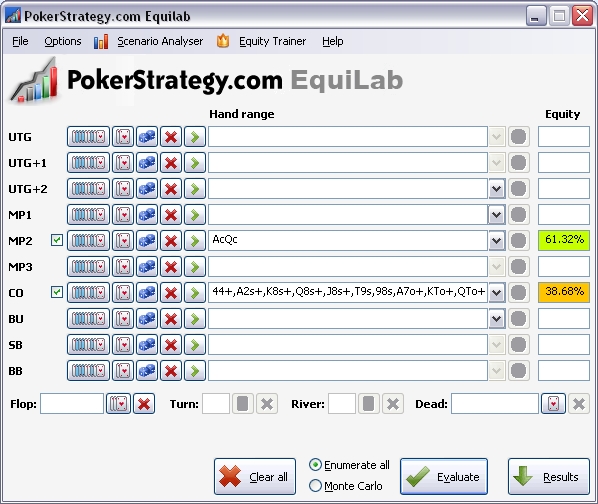
Free desktop classic Equilab is the other free veteran, also from the PokerStrategy ecosystem, with a different interface and a heads-up focus. They overlap heavily; pick whichever workflow feels natural.
More visual, still cheap Flopzilla is the modern step up: free version plus a $25 lifetime licence, instant recalculation, rich visual output (equity graphs, hotness, pie charts) and multiway equity up to 14 players. If you find PokerStove’s manual input tedious, this is the natural upgrade.
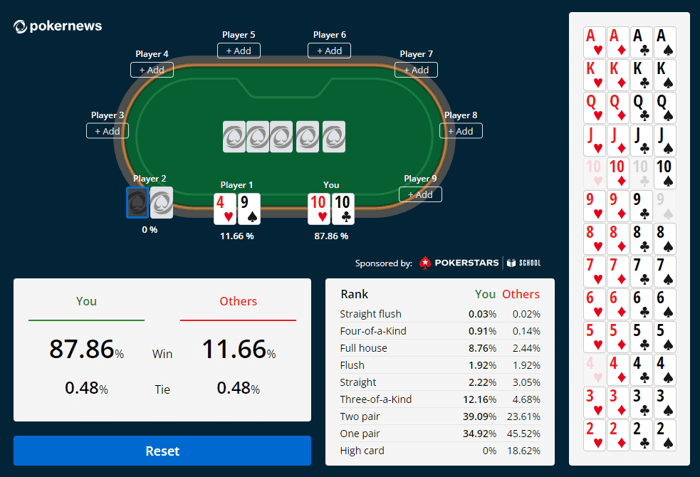
No install at all The PokerNews Odds Calculator is free in the browser — convenient for quick checks, less capable for deeper work.
A different category Solvers such as GTO Wizard or PioSolver answer a different question entirely: not “how often do I win?” but “how should I play?”. And for tournament chip value, look at ICMIZER 3 rather than any equity calculator.
Poker room rules and restrictions
PokerStove is a study tool. Using any software to calculate equity while a hand is live is Real-Time Assistance (RTA) — treated as cheating at essentially every major online room, with bans and fund forfeiture as the standard outcome.
The rule of thumb is simple: use tools like this to learn, never to play. And check your room’s current software policy for its exact position.
Final verdict
Choose PokerStove if: you want free, fast, no-nonsense equity calculations on Windows and you are happy to type in your hands.
Avoid PokerStove if: you are on Mac or Linux, you want polished range work and visuals (Flopzilla), or you are actually looking for strategy answers (that is solver territory).
FAQs
Is PokerStove free? Yes — completely, with no Pro tier or account required.
Where do I download it? From the official GitHub repository (github.com/andrewprock/pokerstove), which hosts the program and its releases.
Does it work on a Mac? No. It is a Windows application.
Can I use it while playing online poker? No. Using any calculator during live play is RTA and is banned by poker rooms.
Does it give betting advice? No. It calculates win probabilities only.
How is it different from a solver? A solver computes the optimal strategy for a spot (what to do); PokerStove computes equity (how often you win). Different questions, different tools.
Is it better than Equilab? Neither is objectively better — they are close cousins. Equilab leans heads-up with its own interface; PokerStove is a minimal classic. Choose by feel.
Relevant alternatives
- Equilab review — the other free classic
- Flopzilla review — modern, visual, $25 lifetime
- PokerNews Odds Calculator review — free, browser-based
- ICMIZER 3 review — for tournament chip-value maths
- Equity Calculators category