If you have spent more than a week studying Texas Hold’em, you have likely heard the name Equilab. As a long-time student of the game, I remember the days when I relied solely on “gut feeling” to determine if my flush draw was profitable. Everything changed when I first ran my ranges through this specific piece of software.
In this comprehensive review, we are going to dissect PokerStrategy.com’s Equilab. We will look past the dated user interface to see if the underlying math still holds up against modern, high-powered solvers like PioSOLVER or GTO Wizard. Whether you are a micro-stakes grinder or a high-roller, understanding how this equity calculator functions is vital for your progression.
What is Equilab? An Overview of the Ultimate Equity Calculator
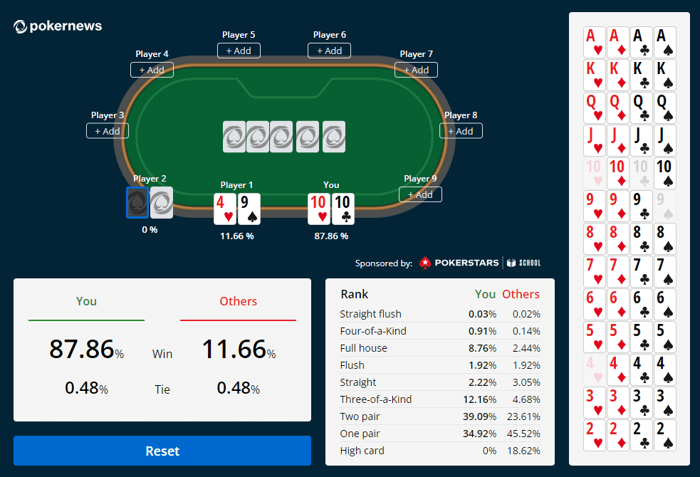
At its core, Equilab is an equity calculator designed to help poker players calculate the mathematical probability of one hand winning against another (or a range of hands) at a specific point in a poker hand.
Unlike complex GTO (Game Theory Optimal) solvers that require massive computing power, Equilab focuses on “what-if” scenarios. It allows you to input specific hole cards and see how they perform against a distribution of hands. This makes it an indispensable tool for studying pre-flop ranges and post-flop equity realization.
The Learning Curve: Is it User-Friendly?
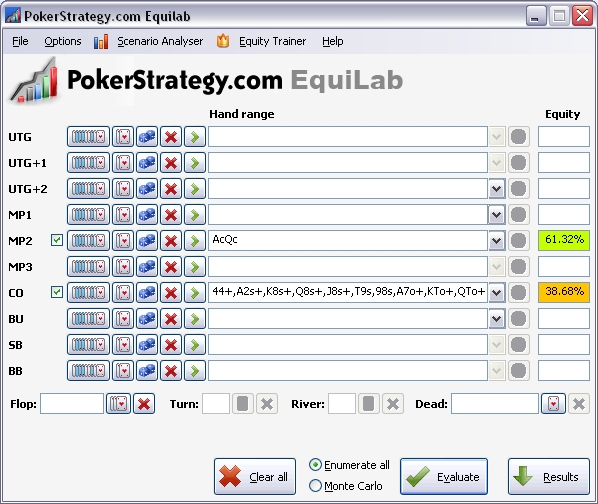
When I first opened the software, I’ll admit—the UI felt like a relic from 2010. It lacks the sleek, dark-mode aesthetics of modern web apps. However, once you understand the input fields, the logic is incredibly straightforward. You aren’t just calculating one hand; you are simulating how a range interacts with the board.
Key Features: Putting Equilab to the Test
To truly understand if this tool provides value, I put it through several real-world testing scenarios. Here is how the software performed during my deep-dive sessions.
1. Range vs. Range Calculations
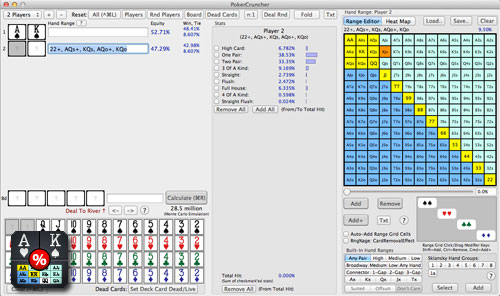
The most powerful feature of Equilab is its ability to calculate equity between two ranges. During my testing, I simulated a common scenario: an Under-the- กัน (UTG) open range versus a Big Blind (BB) defending range on a coordinated board like 8♠7♠6♢.
- Real-World Performance: The software accurately calculated the equity percentage. This is crucial for determining if a “range vs. range” advantage exists, which dictates how aggressively you should be bluffing or value-betting.
2. Hand vs. Range Simulations
This is where I found the most utility in my daily study sessions. If you are unsure if your Top Pair/Top Kicker (TPTK) is a “stack-off” hand against a tight opponent’s 3-bet range, Equilab provides the raw percentage.
- Practical Insight: I used this to analyze my “hero calls.” By inputting the opponent’s perceived range, I could see exactly how much equity I had. If the number was below 35% on a heavy draw board, I knew I was mathematically incorrect to call a large shove.
3. Customizing Board Textures
Equilab allows you to input specific flop, turn, and river cards. This is essential for studying “nut advantage.” While it doesn’t tell you the optimal strategy (like a solver), it tells you the mathematical reality of the board texture.
The Pros and Cons: A Transparent Look
No piece of software is perfect. To give you an honest assessment, I have weighed the benefits against the limitations.
Pros
- Completely Free: Unlike many modern poker tools that require a monthly subscription, Equilab is free via PokerStrategy.com.
- Lightweight Performance: It runs on almost any laptop without hogging RAM or CPU, making it perfect for studying while playing.
- Precision Math: The equity calculations are incredibly accurate for standard Texas Hold’em scenarios.
- Range Building: The ability to create custom ranges (e.g., “Button Open Range”) is a game-changer for pre-flop study.
Cons
- Outdated User Interface: The visual design is clunky and lacks the modern feel of newer software.
- No Strategy Advice: It tells you the probability, but it won’t tell you whether to bet or check. You still need a fundamental understanding of poker strategy to interpret the data.
- Limited to Hold’em: While it can be adapted, its primary strength lies in Texas Hold’em; players of Omaha may find it slightly less intuitive.
Deep Dive: Equilab vs. Modern Solvers
A common question I get from students is: “Do I really need Equilab if I have GTO Wizard?”
The answer depends on your budget and goals. GTO Wizard tells you the optimal frequency (e.s., “Bet 33% of the time with this hand”). Equilab, however, tells you the raw equity.
I find that using them in tandem is the ultimate way to study. Use a solver to find the strategy, then use Equilab to verify the math behind why certain hands are more profitable in specific ranges. If you are a beginner, starting with Equilab is much less overwhelming than jumping straight into complex equilibrium-based software.
How to Use Equilab for Effective Poker Study
To get the most out of this tool, I recommend following this workflow:
- Identify a Hand History: Take a hand from your recent session where you were unsure of your equity.
- Reconstruct the Ranges: Input the ranges as they would have been in the actual game.
- Analyze the Equity Shift: Watch how the equity changes as the turn and river cards are dealt.
- Identify “Dead” Cards: Use the tool to see how certain board runouts kill your range’s equity, helping you recognize when to fold more easily in live play.
The Verdict: Should You Download Equilab?
After extensive testing and integration into my own study routine, here is my final assessment.
Equilab is best for:
- Beginner to Intermediate Players: Who need a free, easy-to-use tool to understand equity and range interaction.
- Budget-Conscious Grinders: Who want professional-grade math without a monthly subscription fee.
- Range Researchers: Who want to quickly visualize how different ranges perform against specific board textures.
Who should skip it?
- Advanced Professionals: You will likely need more robust “solver” technology that provides betting frequencies rather than just raw equity.
Final Thought: While the interface looks like a relic of the past, the mathematical engine inside PokerStrategy.com’s Equilab is as powerful as ever. It remains one of the most essential free resources in the poker player’s arsenal. If you want to stop guessing and start calculating, this is your first step.
Try Equilab Today
Ready to take your game to the next level? Click below to get started with Equilab:
Visit Equilab Official Website →
Disclosure: This post contains affiliate links. If you click through and make a purchase, we may earn a commission at no extra cost to you. We only recommend tools we genuinely believe will help improve your game.